Matchday Programme or Keepsake: Which One Should You Choose?
Compare a matchday programme with a personal keepsake to choose what suits your plans, then store it with enough context to make sense of later.
The common mistake with a matchday programme is expecting it to serve as both a useful guide and a personal keepsake. Once the team news and practical details are no longer needed, it can feel impersonal; the cost is a purchase that does not answer the reason you wanted to remember the day. A programme or keepsake serves a different purpose: one helps you follow the occasion, while the other connects you to a particular part of it.
Choose by asking what you want to recall later: information about the event, or a specific connection to being there. These distinctions can help you decide what to pick up, keep and look back at.
What do you want a matchday programme to recall?
A matchday programme belongs to the event’s public record. It may bring together team line-ups, player profiles, competition details, editorial notes and information about the ground. Its value can lie in showing how the club presented the match at the time, even when some details are no longer useful.
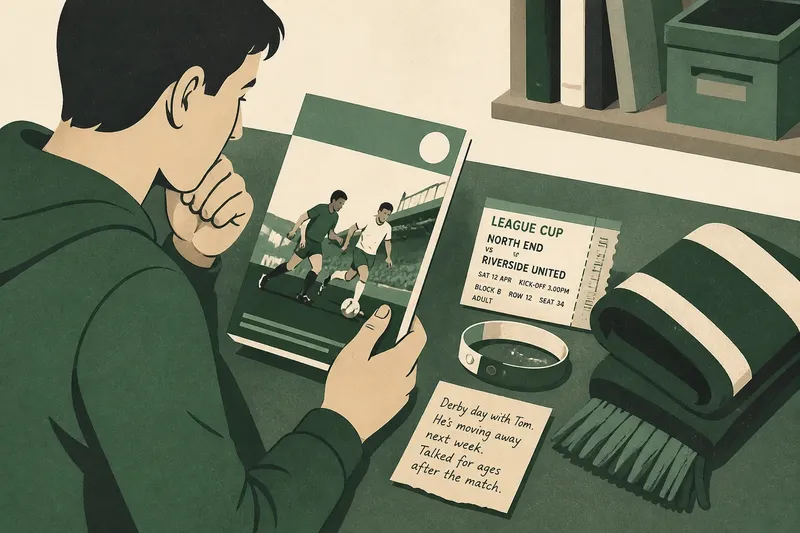
A keepsake is more personal. It might be a ticket, a paper wristband, a scarf bought for that fixture or a small item connected to the people who came with you. Its meaning need not be legible to anyone else. A ticket stub can work like a key on a ring: modest in itself, but able to open a very particular memory.
Try naming the thing you hope to recall. If it is who played, what was at stake or how the club framed the fixture, the programme is a natural choice. If it is the friend beside you, a family ritual or the design of the turnstile ticket, a personal object may carry more weight.
When is a programme most useful?
A programme earns its place when you want information in your hands during the match. It can make an unfamiliar competition or squad easier to follow, and printed details can give conversation a starting point before kick-off. Its editorial pages may also show what the club wanted supporters to notice about that occasion.
Judge the contents, not just the cover. Look for material tied to the match: current team information, clear fixture context, relevant notes or writing that offers more than general promotion. A beautifully designed issue may still tell you little about the game; a plain one may contain the details you need.
Say you are attending a cup tie with relatives who rarely follow the club. The programme on sale has the teams, competition background and brief player introductions. You read those sections together while waiting for play to begin; the expected result is that everyone has more context for what they see, while the programme remains a reading aid rather than a record of the whole day.
Which keepsake holds a personal memory?
Choose an object that connects to a moment rather than one that merely carries a club name. A ticket printed for the fixture, a handwritten note exchanged at the ground or a scarf chosen for a shared outing can retain a specific association. It need not be official or expensive; it needs a clear link to the day in your own mind.
Think about what makes the object distinct. A ticket may carry the ground’s typography and fixture details; a scarf might recall a family tradition of wearing the same colours. Those material and visual cues can matter more than a broad label such as “football memorabilia”.
Imagine you attend a local derby with a sibling who is moving away. You keep the ticket and write on a separate slip that you travelled together and talked after the match about the move. The expected result is an object paired with its personal context, rather than an unexplained ticket stored among unrelated papers.
How do you choose between a programme and a keepsake?
Consider what you want the item to do now and later. A programme is suited to reading and reference; a keepsake is suited to personal association. Some objects can serve both purposes, but they do not have to. Buying both makes sense only if each answers a different desire.
- Check whether you want match information. If you would read team details or club writing during the event, choose the programme; if not, leave it and consider a keepsake instead.
- Check whether a personal object has a clear link to the day. If a ticket, wristband or scarf recalls a person or ritual, keep that item; if the connection is vague, choose a more specific object or keep nothing.
- Check whether the programme and keepsake serve separate purposes. If you would read one and value the other for its personal association, choose both; if they would duplicate the same role, choose the one you prefer.
- Check whether you want to store anything. If you have a suitable dry, protected place, keep the paper item you value; if storage would become a burden, leave it behind and rely on a note or memory instead.
- Check whether the printed item is fragile or marked. If it is clean and intact, store it flat in a dry place; if it is damp, torn or delicate, avoid adhesive and seek suitable archival advice before attempting repairs.
- Check whether the object will make sense later. If the fixture or person is clear from the item, file it with its context; if not, add a separate note with the match and companion, or reconsider keeping it.
Keep the distinction in view: a programme can be read, shared and revisited as an account of the match, while a keepsake can preserve a personal association. Neither needs to become a complete record of the occasion.
What do readers ask about matchday programmes and keepsakes?
Can a matchday programme be a souvenir?
Yes, particularly when its cover or contents are specific to a fixture you remember. Its usual purpose is to inform or accompany the event, so its value as a souvenir depends on what you associate with it.
What is a good keepsake if I do not collect memorabilia?
Choose one small item with a clear connection to the day, such as a ticket or a note from someone who attended with you. Keep a separate label with it if the link might not be obvious later.
Should I buy a programme at every match?
Only if you enjoy reading or collecting them. If you mainly want information, choose issues whose contents you will use; if you want a memory of a particular occasion, select those fixtures rather than accumulating every copy.
How can I remember a match without keeping an object?
Write a short note after the event about who was there, what you noticed and what you talked about afterwards. This can preserve details that a printed programme was not designed to record, without adding another item to store.
How can you keep the item legible later?
For paper, favour a dry, protected place and avoid adding adhesive or writing directly on material you may want to preserve. If you want to note the fixture or companion, use a separate slip and keep it with the programme or ticket. Follow any care guidance supplied with an item, particularly if it is fragile.
For the choice between a matchday programme or keepsake, let the object answer a specific need: match context to read, or a personal association to retain. A little context alongside the item can make that choice clearer when you come across it again.